March 25, 2010

Herb Ritts


Herb Ritts was born in California in the '50s, a time when women began to assert itself with a more strong and seductive image, the miniskirt emerged and women began to lose their fear to show the flesh. As a child he helped his father doing carpentry work, but must be the influence of his mother, an interior designer, which sparked his interest in the aesthetic which he reflected through the photography.At college he studied art history which certainly opened his mind to new cultures and artistic expressions that lacked the sunny California, without studying photography but with great intuition all he had to do was refine its view of the world, experimenting with their tastes without engaging both the art and the study. In fact in his own words he define what he really is "many people who excel are self-taught" , that great truth.


Not bad to start having a career with a neighbour as Steve McQueen and remain friends with Richard Gere, in fact his first photograph when he still didn't considered himself a photographer was Richard in a desert gas station, Gere has just shot his first movie and this picture later appeared in many media, Herb instantly came up with the opportunity to photograph Brooke Shields, so he took courage and did not let the chance escape, for a talented person the road was sealed.Herb Ritts's photographs clearly have a sculptural aesthetic, with a palpable force and remarkable warmth. He was a true black and white artist, elegance and lightness of his images do not go unnoticed and let alone the worship of the human body. 
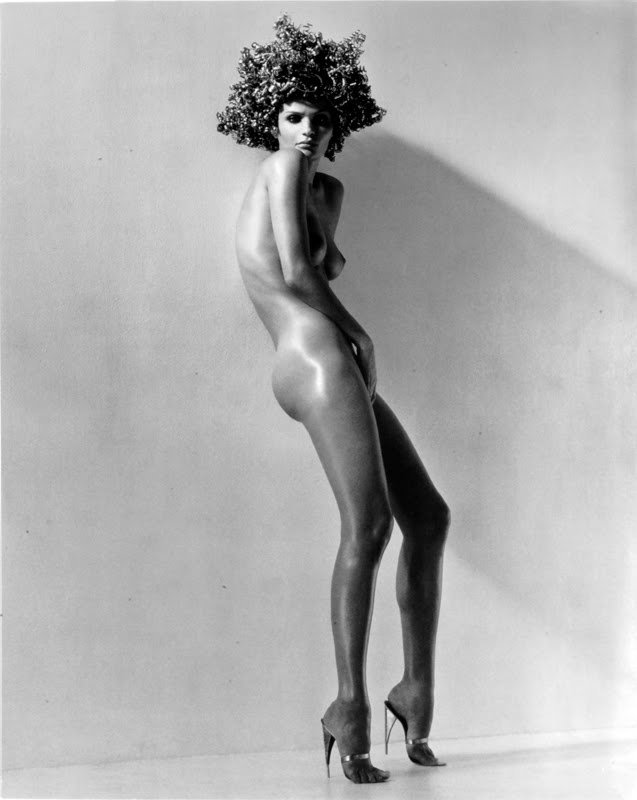


If anyone has portrayed the tops of the 90s as Cindy Crawford or Christy Turlington, that's Herb Ritts, no doubt he was one of the photographers that towered these beauties into the kingdom of heaven from they would never get off.
His job shows the innate sensitivity of light, texture and warmth, he used large planes and spaces, areas of texture and light, like deserts or oceans or monumental places. This hobby is well reflected in his trip to Africa, since it did not matter if he was halfway around the world in a foreign country cause all these elements are universal, an image expresses a universal language.


As a true Californian his images express freedom, openness, lightness and cleanliness, his work is mutually own free and open. One of his biggest hits was "Fred with Tires" an honest image which found to be quite an achievement since, as often happens when the model "stop" posing emerges the best picture. His images are sensual rather than erotic, sensuality oozing from every pore.


DUO was his first published book, was an innovation of the time since it was the first book that showed images of same-sex partners. This meant that in some unconscious way the book should have become a benchmark for the fight against sex discrimination.Herb Ritts portraits are undoubtedly the best that you can see, you can feel the person you have in front, their inner quality is what makes them who they are. Frequently Herb commented that the most interesting people to photograph were the elderly, whom have lived their lives, that is reflected in their face.


An example is the wonderful picture Herb took when Elizabeth Taylor left the hospital after brain surgery, a very explicit picture in which the actress is seen with white hair and a scar from the operation, a distinct and unique photo, timeless. Herb Ritts has always said he likes photographing wrestlers, people who have survived. What matters is who the person is, the true inner beauty.Herb Ritts work has not been a merely photography, not pleased with his good work he aspired more. Herb has made some of the most sensual and memorable music videos of all time, who can forget the famous Chris Isaak's Wicked Game with  a  very young Helena Christensen but nothing innocent, a magnificent close-ups and all very detailed, let's keep dreaming to be part of that Wicked Game. Another of the most rated music video of Herb was Cherish by Madonna, where he is continuing smooching in the sand, hinting at and where we would like to be sirens to find some dolphins so muscular and strong as this magnificent artist shows. If Herb Ritts managed something pretty well is to awaken the desire in all its viewers.


On the other hand, we can not ignore how many commercials he has done for brands like Rochas, Calvin Klein, Revlon, Levi's and Victoria's Secret among others, always showing the potential of models and beauty unattainable.

Many of his photographs show us the preciousness of the male body, a strong muscular man who is in the Olympian gods, Greek sculptures were never as perfect as Herb Ritts male models. His excellence male model was Tony Ward, former boyfriend of Madonna and the most desirable man of the '80s, without a perfect physiognomy is one of those ugly men than dazzle, is mystery. Backflip '87 it's the most glaring picture, not forgetting the session with Cindy Crawford for Playboy in which she showed wicked seductress.


I could write about Herb Ritts for hours and never get tired, but I think here it is time to simply enjoy his legacy and not ever get tired of appreciating the wonderful subtlety with which a body can be photographed


.

February 9, 2010

The luxury of Haute Couture


Is fashion old-fashioned?


In a time where technologies surround and overwhelm us, in which people have no time to stand and watch or enjoy, a time when everything moves so fast that becomes obsolete just outside the market, does fashion accommodate as visionary object and study of trends?. Is it possible to find a niche in a competitive and stocked market?, or is fashion doomed  to stock up of frustrated characters by not being able to meet the urgent demand for its consumers?. It is mandatory to look back to think about fashion today.


 The luxury market it's becoming less, virtually everyone has access to observe or appreciate for a moment what luxury life means, we see in magazines, media and especially on the Internet (dangerous way to reach anything, any place with just one click). Luxury is devalued, big fashion houses dedicated to make exclusive dreams to counted characters don't do so lately. Today we see any celebrity wearing what has been presented on the runway a few weeks earlier, there are not luxury consumers because they realize that they aren't so unique, they don't possess the unique work of art for which they pay to "hang on their walls". The luxury has to be secret, intuitive, desired but never standardized. Some brands with economic and advertising needs collaborate with normal and commercial fashion companies, and then is when they lose a part of its essence. In a world where we have it all, shouldn't we return to the essence of small detail?. Honestly, we have to stop and appreciate things.


Fashion is a daily devotion, full of life and culture which makes it possible for people to match their personality with a style,  a look that makes them feel safe, powerful, handsome. Fashion is one tool in our society through which we express ourselves, and luxury in fashion is the master key,  few can have it but all want itTherefore comes the need to revive Luxury and big brands; today all belong to business holdings that orchestrate their marks to act together, hence the need to customize, we can only hope that the industry stops and resurgence as only knows how: with dignity, identity, quality and dreams of haute coutureYou can't forget masters as Christian Lacroix, Cristobal Balenciaga, Madeleine Vionnet and Christian DiorLet us follow the example of Hermés; the luxury costs a lot because it's unique, elaborate and expensive, very expensive. A new Era has to begin, it's therefore necessary to return to the past.


January 20, 2010

Fearless photographer


John Rankin is an scottish photographer who co-founded Dazed & Confused with Jefferson Hack in 1991.


Rankin has gained his reputation as one of the best photographers of the moment thanks to his craftiness while shooting and the intimacy of which are endowed his images. Among his most iconic images, there is a prostrate naked Kylie Minogue or a rather unusual Queen Elisabeth II smiling, a photography to be reflected in his career forever.


John Rankin is one of those photographers who is not afraid of anything, from domestic violence to portray the naked body in all its glory. One example is the Dove campaign which shows women with curves and without complex, outside the stereotypes set nowadays, or his campaigns for charitable organizations. His ambition knows no bounds, Rankin is a photographer, editor and film director and each project he perform has his own seal. His works are intimate, refined, witty and paradoxical. He's one of the few that works a free way, not repeated himself neither followed the line. I specially like his images of flowers in full blaze of color, such a great intensity and beauty.


His photography is for people who are going to look, observe and understand the work.


January 9, 2010

Rudi Gernreich


 Rudi Gernreich was one first class Fashion Designer of America in the 60s. Born in Vienna in 1922 and emigrated to America to escape the Nazis in 1938. The son of a manufacturer of tights and born in a Viennese intellectual family in the decade of the 20, Gernreich was predisposed to become one of the most revolutionary designers of the 20th century.


 His greatest success and launching was in the swimwear line, influenced by the Bauhaus functionalism conceived a design based on wearing underwear coordinated to celebrate the unfettered movement of the body, hence arises the "monokini", Rudi uncovered the women, freed from all bondage and thus was disowned by friends and strangers. In the edition that went on sale sold 3,000 units in just one summer, and thus received a proposal concerned a magazine to design a cover story so he made the monokini that came back dressed by a prostitute, there to stardom.
 Gernreich changed the way women dress, at the beach the swimsuit model unstructured by Gernreich remains the preferred model for women.


 Gernreich invented the bra "unsupported" in 1964, it was a soft nylon bra with no padding or boning in the breasts naturally assumed their instead of being molded into an aesthetic ideal.

 All this happened in the late '50s and early '60s, it was a time when the designer shocked the fashion world for their unusual color combinations such as pink and orange mixed with red purple and blue green, all interspersed with dots and dashes. His work always controversial but original, altered the course of fashion for generations to come.
 Gernreich was the first to use vinyl for garments, and not interested in any haute couture or the red carpet, what he wanted was to dress the common people and used the street as a showcase itself.


 Another term he invented was "unisex" for clothing, which earned him many detractors called him a lewd, but his admirers always saw it as what it was, a great visionary of fashion, a designer risky, whose clothing have always been endowed with agility, grace, full of sense of humor. He conceived of clothing that could be exchanged between men and women, such as the caftan that reaches the ground or flared trousers made of point. If a mistake was made not to cooperate with U.S. stores and no link to the French fashion, which in a decade on 50-bit enabled you to do.


 Gernreich was more interested in how they looked up their designs in detail or decoration. And continued to show his sympathy for the liberation of women with their collection of 1971 in which women wear safari dresses military-style. Other innovative designs were the first shirtwaist dress, blouses, coordinated sets of clothing, bags, hats and socks.


 He was a great experimenter of fabric, such as the constant research of potential that could have the vinyl or plastic. His clothing has been part of an overall design philosophy, ranging from furniture design, kitchen accessories, blankets, bedspreads and even in 1982, gourmet soups.
 Like any artist, Rudi Gernreich had a muse, and it was Peggy Moffitt (recognized model of the 60's) that along with her husband, the photographer William Claxton eventually forming a single triad in the mid 60s. They based their main idea by incorporating the-art fashion but always with futuristic search results. Unlike Pierre Cardin and Andre Courreges, who designed from a perspective focused on the exclusivity of haute couture, Rudi Gernreich always had very clear vocation to design a practical motive for the women of the time, even though their cutting-edge online had an impact as a visual motif that as practical realization.


 Certainly Rudi Gernreich was never considered one of the "great" because of his own commitment to their ideals and the fact of living life as he wanted and felt. He was always honest in his work, did not participate in projects that did not fit his character and perhaps for that very reason was more anonymous, because he decided to go his way without looking, or care what the rest of their colleagues did. He would not succumb to the charms of Haute Couture and therefore there are ladies who still today would be eternally grateful to him for freeing them from the sobriety and simplicity of the clothes they wore and even more to clear the minds of viewers by providing images and dresses for memory.


January 7, 2010

The End of a Decade


It's been a month since my last post, and because we are now in a New Decade and it seems time is running so quickly, i think sometimes we need to stop and look back to what matters and what a lifetime has show us. For that and many other reasons, i would love to share with you my deep admiration for one of the greatest fashion photographers of all time: Richard Avedon.


It takes a lifetime to admire and describe the work of the great Richard AvedonThe photographs in this New Yorker born in 1923 and son of Jewish parents are an icon of our times. You could say that one of its major contributions to fashion photography was the incorporation of motion pictures, and the momentum with which he endowed his photographs, an almost cinematic frame. He was a pioneer in this sense because the photographers before him had never so clearly. But Richard Avedon did not remain stagnant in the world of fashion, if the other obvious reason is a mainstay of photography is due to his portraits, always made a close shot black and white, they all have a really transparency that invites you to know the hidden inner world and character, as a psychological portrait.
Richard Avedon has a large collection of portraits ranging from actors, dancers, musicians, writers and politicians to anonymous people. In fact one of their portfolios and become more known book is "In the American West" is a series of portraits on the deeper America. Richard decided to portray the characters who remain most hidden in anonymity and who live discreetly putting their jobs and living with their families. This trip raises some of his most famous photographs as we see with Ronald Fischer, this is a very powerful and spontaneous photography as Avedon decided to put an ad in the newspaper looking for a beekeeper being the first to be introduced.It is a collection of images worthy of observation and analysis. 


The journey through the American West was made in the very height of his career, the late 70s and early 80s. It began in the fashion world doing work for the magazine Harper's Bazaar and later became Chief of the same picture, succeeding the magazine collects some of his best work. While not entirely devoted to the Magazine, in 1965 he left  to begin in Vogue magazine. Perhaps his foray into the world of fashion meant a revelation because of how their images projected, it made the image of the models were more lively and light. Not only had a passion for pretty pictures but looked surprised, like when he begins to portray characters that did not impact and gives them dignity, a reflection of this are the photographs to China Machado, namely a three-quarter shoot of China with her body almost sideways and cigarette in hand as she lift her index finger slightly with a fantastic costume by Ben ZuckermanFollowing this picture, China became a full time model but quickly turn away the work to become fashion editor of Harper's Bazaar. 


Avedon editorials are like stories, with an introduction, development and conclusion enter the narrative in them, everything is orchestrated.
Another innovation in photography are his margins in the images as a black edge which provide them with great naturalness and improvisation but nevertheless it was much studied. Before him, no other photographer had done it and shot images that used to cut large format not so by him.  Another example is his photographs of Andy Warhol's Factory with all its characters posing standing, the left half is naked while leaving the right half wearing dark clothing, another image for posterity. 


Avedon became the first photographer working for The New Yorker magazine, and in which until 1992 had only done illustrations.
 Some of the models and actresses that posed for Avedon like Verushka, Penelope Tree, Natassja Kinski or Lauren Hutton owe much appreciation and recognition to this master. But the truth is that real Avedon's muse was Audrey Hepburn, whose first contact was with the movie Funny Face, where a fashion photographer is portrayed in reference to Avedon and in which he gave some of his photographs as is the case of an Audrey Hepburn depicted only in profile. Avedon went on to say about Audrey "I am, and forever will be, devastated by the gift of Audrey Hepburn before my camera. I cannot lift her to greater heights. She is already there. I can only record. I cannot interpret her. There is no going further than who she is. She has achieved in herself her ultimate portrait." 


Richard Avedon died on October 1, 2004 because of a brain haemorrhage while on an assignment for The New Yorker leaving a legacy of 50-year career and many of the photographs most closely watched, admired and reproduced. The great fashion photographer died, but his images never die, persist over time and live in our memories, books, magazines, poses, models and of course in our retinas;  was, is and will one of those photographers that move, that reflects the emotions beyond mere posturing, there is a big universe known through its images.